
One of the most common questions beginners ask is how deep can a metal detector detect. Many people imagine metal detectors as powerful devices that can locate coins, jewelry, or relics buried several feet underground. In reality, detection depth is influenced by several important factors, and expectations are often higher than what most hobby detectors can realistically deliver.
To properly understand how deep a metal detector can detect, it helps to first understand (what a metal detector is and how it works). Detection depth is not a fixed number — it changes depending on the size and type of the target, ground conditions, coil design, and even how the detector is used.
Metal detector depth plays a major role in a beginner’s success and enjoyment of the hobby. When expectations are realistic, metal detecting becomes far more rewarding and far less frustrating. In the sections below, we’ll break down what affects detection depth, what beginners can realistically expect to find, and why understanding depth is more important than chasing exaggerated claims.
The Short Answer: Metal Detector Depth Explained
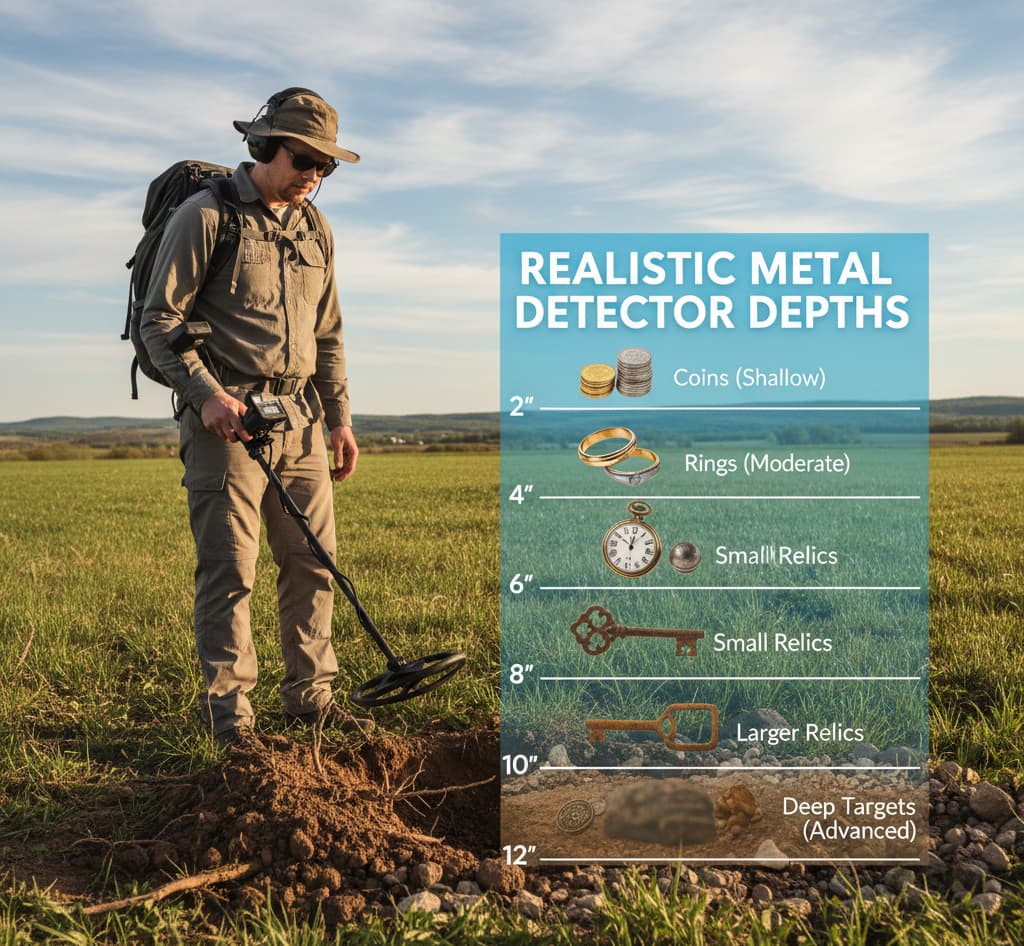
So, how deep can a metal detector detect in real-world conditions?
For most beginner and hobby-level detectors:
- Small objects such as coins or rings are typically detected 5–10 inches (12–25 cm) deep
- Larger metal objects can sometimes be detected deeper, especially in clean and low-mineralized soil
There is no single depth number that applies to every situation. This is why understanding how metal detector depth really works is far more useful than relying on advertised depth claims.
What Affects Metal Detector Depth?
Several key factors directly affect metal detector depth, and all of them work together to determine how deep a metal detector can detect objects underground. This is why there is no universal depth number that applies to every detector or situation.
Many beginners are surprised when their results differ from what they expected. In most cases, this happens because they are unaware of how strongly these variables influence detection depth.
To better understand why depth changes, it helps to first understand (how metal detectors work) and how they interact with metal targets and ground conditions.
Target Size
Target size has a direct and significant impact on metal detector depth. Simply put, the larger the metal object, the stronger the signal it produces, allowing the detector to identify it at greater depths.
Small targets, such as thin coins, small jewelry, or tiny metal fragments, produce weaker signals. Because of this, they are usually detected closer to the surface, often within the top few inches of soil. This is why beginners sometimes feel disappointed when their detector does not detect small objects deeply — it is a normal limitation, not a fault of the device.
Larger metal objects behave very differently. Items such as large coins, metal relics, or bigger pieces of iron generate stronger electromagnetic responses. In ideal conditions, these larger targets can sometimes be detected at significantly greater depths, especially in clean and low-mineralized ground.
It is also important to understand that shape and orientation matter. Flat objects lying horizontally are usually easier to detect than objects positioned vertically or at odd angles. A large object placed edge-on may produce a weaker signal than a smaller object lying flat.
For beginners, the most important takeaway is this: depth expectations should always match the size of the target. Most valuable beginner finds — coins, rings, and small relics — are usually located relatively close to the surface, which is why proper technique and patience matter more than extreme depth claims.
Type of Metal
The type of metal you’re trying to find can noticeably affect detection depth. While many beginners assume depth depends only on the detector, the truth is that different metals produce different signal responses — and some are simply easier to detect than others.
In general, highly conductive metals tend to be easier for hobby detectors to detect at greater depths. These often include:
- Silver
- Copper
- Brass
Coins made from these metals often produce strong, stable signals, which is why many beginners have better success finding them compared to tiny gold jewelry.
On the other hand, low-conductive metals can be more challenging, especially when the target is small. This includes many gold items, particularly:
- Thin gold rings
- Small gold earrings
- Tiny gold chains
Gold is a great example of why “depth” is not a simple number. A small gold item can be hard to detect even at shallow depth, while a larger silver coin may be detected deeper under the same ground conditions.
Another important factor is iron and steel. Iron is very common in the ground, and it can be detected easily — sometimes even at surprising depth. The problem is that iron signals can be misleading. Rusted iron objects may produce unstable signals, and many beginners waste time digging trash because they assume every strong signal must be a valuable target.
This is also where target identification (ID) and discrimination settings come into play. When discrimination is set too aggressively, you can accidentally reduce sensitivity to certain targets. Beginners sometimes “filter out” signals and then wonder why they are not getting good depth or why they are missing potential finds.
The key takeaway is simple:
Depth depends on what you’re searching for. If you mainly want coins, you may experience more consistent depth and clearer signals. If you’re hoping to find small gold jewelry, expectations should be more conservative, and technique matters even more.
Ground Conditions

Ground conditions have a major influence on metal detector depth, often more than beginners expect. Even a good detector can lose significant depth performance if the ground itself interferes with the signal.
Different types of soil, sand, and terrain affect how electromagnetic signals travel underground. This is one of the main reasons why a detector may perform very differently from one location to another.
To better understand this, it’s important to consider (where you will use your metal detector), since location and ground type are closely connected.
Clean and Low-Mineralized Soil
In clean, low-mineralized soil, metal detectors usually perform at their best. Signals travel more easily through this type of ground, allowing detectors to reach greater depths and produce clearer target responses. Many parks, fields, and farmland areas fall into this category, which is why beginners often have their best early success there.
Mineralized Soil
Mineralized soil contains naturally occurring metals and minerals that can interfere with detection signals. In these conditions, metal detectors may lose depth, produce unstable signals, or struggle to accurately identify targets. Highly mineralized ground is one of the most common reasons beginners feel their detector is “not deep enough,” when in reality the ground is the limiting factor.
Sand and Beach Conditions
Dry sand generally allows good detection depth, similar to clean soil. However, wet sand and saltwater environments are much more challenging. Salt content can behave like a large metal target, overwhelming the detector and reducing effective depth unless the detector is properly designed or adjusted for these conditions.
Rocks, Clay, and Compacted Ground
Hard-packed soil, clay-heavy ground, and rocky terrain can also reduce practical depth. Signals may not penetrate as efficiently, and digging deeper targets becomes more difficult. In these environments, many detectable objects are found closer to the surface simply because deeper items are harder to reach.
Why Ground Conditions Matter for Beginners
For beginners, understanding ground conditions is critical. Depth expectations should always be adjusted based on where you are detecting. A detector that performs well in one location may behave very differently just a few miles away due to changes in soil composition.
Recognizing how ground conditions affect metal detector depth helps you choose better locations, adjust settings more effectively, and avoid unnecessary frustration.
Coil Size and Design
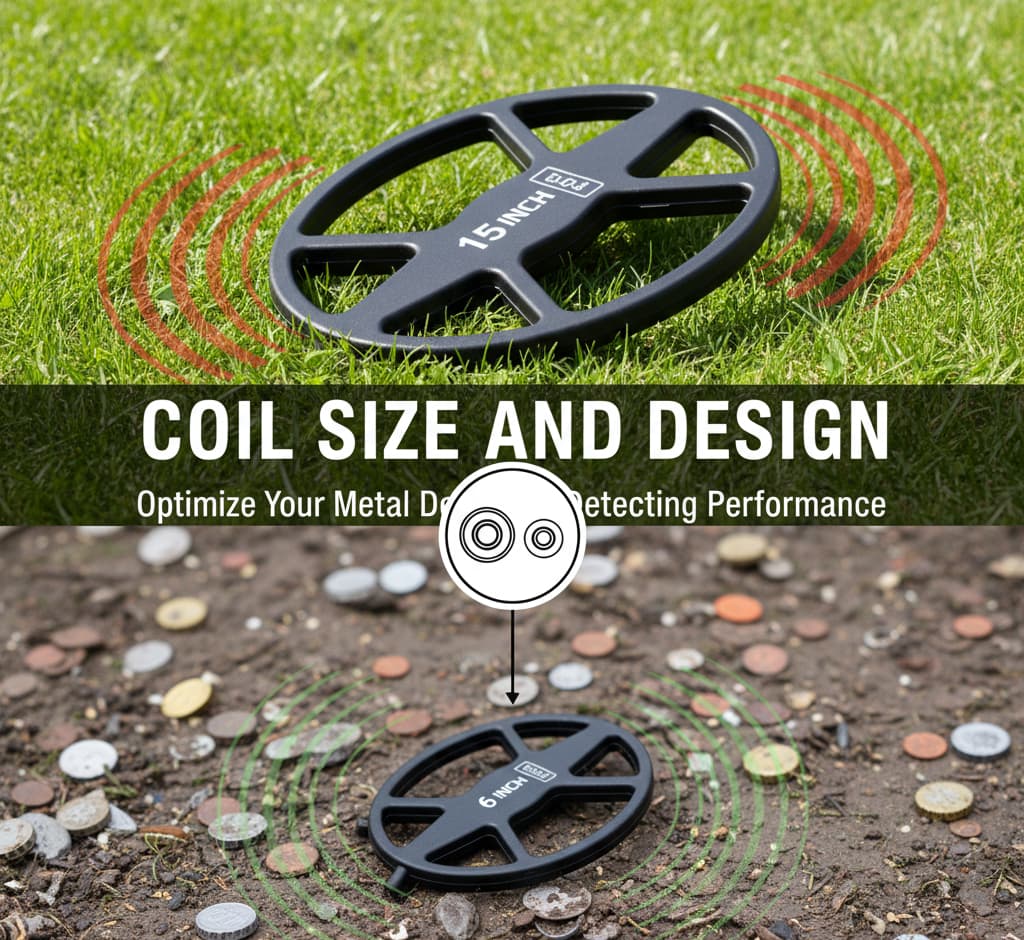
Coil size and design are major factors that influence metal detector depth. Many beginners focus only on the detector itself, but the coil is the part that actually transmits and receives the signal. Changing the coil can noticeably change how deep a metal detector can detect, how well it separates targets, and how stable the detector feels in difficult ground.
Coil Size: Small vs Large
In simple terms, larger coils tend to detect larger targets deeper, while smaller coils offer better control and precision.
Smaller coils are usually better for:
- Finding small targets in trashy areas (many signals close together)
- Working in tight spaces (around rocks, roots, or heavy vegetation)
- Improving target separation so you can pick out good signals near junk
- Maintaining more stable performance in some mineralized conditions
The trade-off is that small coils generally have less depth on larger targets compared to bigger coils, especially in clean ground.
Larger coils are usually better for:
- Covering more ground per sweep (faster searching)
- Reaching deeper targets, especially medium-to-large objects
- Detecting larger relics or caches at greater depth
However, larger coils can struggle in trashy areas because they “see” more targets at once. This can create mixed signals and make it harder for beginners to identify what’s actually under the coil.
Coil Shape: Round vs Elliptical
Coil shape also affects practical results.
- Round coils are common and tend to provide balanced performance for general searching.
- Elliptical coils can be easier to maneuver and may help in tighter areas. They are also useful for scanning narrow spaces and can feel more precise in certain conditions.
The difference is often about practicality and control rather than huge depth changes, but shape can still affect how easy it is to pinpoint and separate targets.
Coil Type: Concentric vs DD
Two common coil designs you’ll see are concentric and DD coils.
Concentric coils often:
- Pinpoint easily
- Provide strong, clean signals in mild ground
- Work well for general detecting in parks and fields
DD coils often:
- Handle mineralized ground better
- Perform more smoothly in difficult soil
- Reduce some types of ground interference
- Can provide more consistent depth performance in challenging conditions
This is one reason many detectors designed for tougher ground conditions use DD coils as standard.
Why Coil Choice Changes Metal Detector Depth in Real Life
In real-world detecting, “depth” is not just about maximum reach. It’s also about how clearly the detector can recognize a target and how stable the signal is.
A coil that is technically capable of good depth may still feel “shallow” if:
- the ground is mineralized
- there is lots of trash
- targets are close together
- the detector becomes unstable and you have to lower sensitivity
In these situations, the best coil is often the one that gives you the clearest, most repeatable signal — not necessarily the one that claims maximum depth.
Beginner Advice: What Coil Should You Use?
If you’re a beginner, the best approach is usually:
- Start with the stock coil your detector came with
- Focus on consistent technique and learning your signals
- Consider a smaller coil if you often detect in trashy parks
- Consider a larger coil only if you mainly search clean areas and want more coverage
The most important point is that coil upgrades should match your location and goals. A coil that improves depth in one environment may not be the best choice in another.
Detector Settings and User Technique
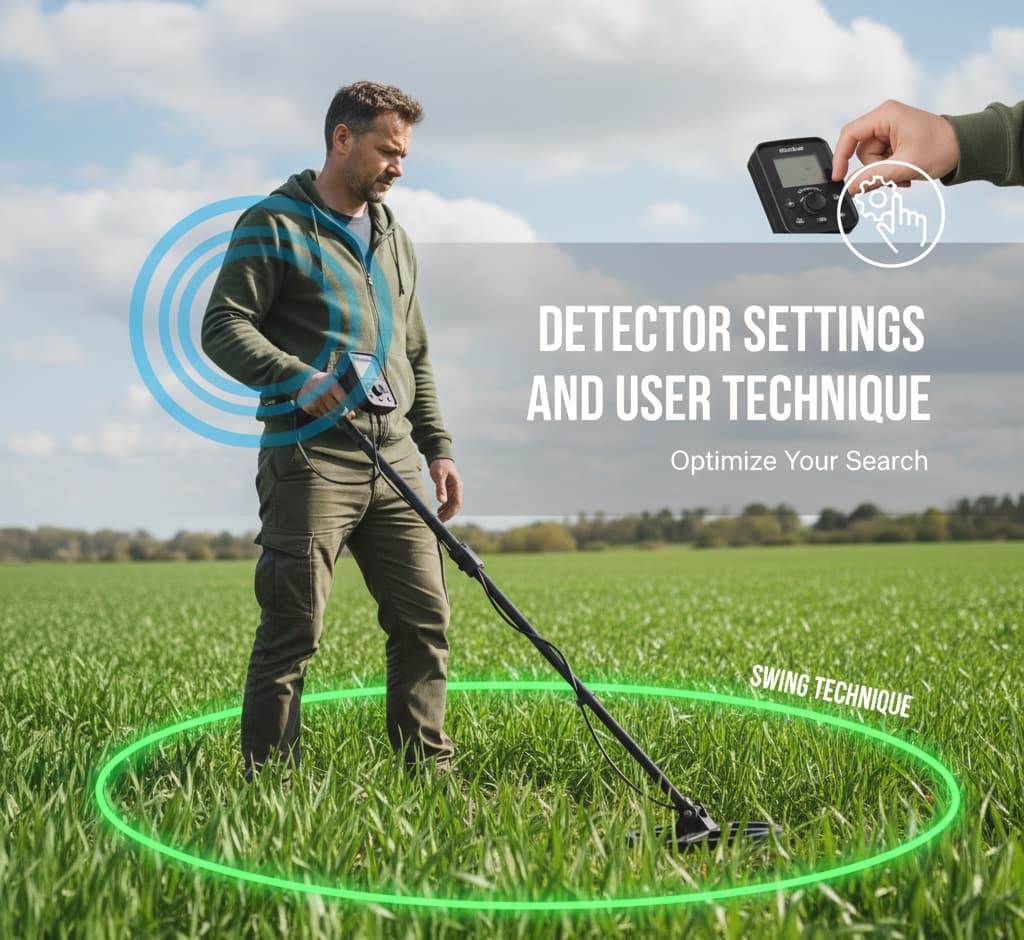
Even with the same detector and coil, two people can get very different results. That’s because detector settings and user technique have a big impact on metal detector depth. In many cases, beginners lose depth not because their detector is weak, but because the settings or technique are working against them.
If you’re new to detecting, don’t worry — you don’t need perfect settings. But understanding a few basics can noticeably improve depth and signal clarity.
Sensitivity: More Isn’t Always Better
Sensitivity is one of the first settings beginners increase when they want more depth. While higher sensitivity can help, pushing it too high often causes instability, false signals, and noisy performance.
When the detector becomes unstable, beginners usually do one of two things:
- They ignore many signals because it feels “too noisy”
- They swing faster or lift the coil to reduce the noise
Both of these reduce real-world depth.
A good rule of thumb is to raise sensitivity until the detector becomes unstable, then back it off slightly until signals feel repeatable and controlled. Stable performance often produces better real-world depth than maximum sensitivity.
Discrimination: The Hidden Depth Killer
Discrimination helps filter out unwanted targets like iron, but overly aggressive discrimination can reduce depth and cause missed finds.
When you block too many ranges:
- weak signals can disappear
- borderline targets become harder to recognize
- target ID becomes less reliable at depth
This is especially important for beginners because deeper targets naturally produce weaker signals. If discrimination is too strong, the detector may “silence” those weaker responses.
Tip: If you’re learning, use moderate discrimination and focus on digging repeatable signals rather than trying to filter everything perfectly.
Ground Balance (If Your Detector Has It)
Ground balance is a major factor in difficult soil. If the ground is mineralized and the detector isn’t properly balanced, you can lose depth and get unstable signals.
Some detectors handle this automatically, while others allow manual adjustment. The goal is simple: reduce ground interference so the detector can focus on real targets.
When ground balance is off, the detector may:
- become noisy
- misidentify targets
- lose depth performance
If you detect in changing soil types, learning the basics of ground balance can be one of the fastest ways to improve metal detector depth.
Recovery Speed and Target Separation
Some detectors allow you to change recovery speed (how quickly the detector responds to multiple targets).
- Faster recovery can help in trashy areas (better separation)
- Slower recovery may provide slightly better depth in cleaner ground
Beginners don’t need to obsess over this, but it explains why detectors can behave differently in parks versus open fields.
Swing Technique: The #1 Beginner Factor
Technique matters more than most beginners realize. The best settings won’t help if the coil isn’t used correctly.
For consistent depth:
- Keep the coil low and level to the ground
- Avoid lifting the coil at the end of each swing
- Swing at a steady, controlled speed
- Overlap sweeps slightly so you don’t miss narrow targets
A very common beginner mistake is “air-swinging” — the coil gradually rises as you swing. Even a small increase in coil height can reduce detection depth noticeably.
This is why many beginners feel their detector has poor depth: the detector is fine, but the coil is not staying close enough to the ground.
When Signals Are Weak: How to Check a Target
Deep targets often produce weak or inconsistent signals. Before ignoring them, try:
- making shorter, slower sweeps over the spot
- turning 90 degrees and sweeping again
- reducing discrimination slightly
- lowering sensitivity a bit if the detector is unstable
These simple checks can help you separate real deep targets from random noise.
To avoid the most common beginner errors with settings and technique, you can also review common metal detecting mistakes beginners make.
Realistic Expectations for Beginners

One of the biggest reasons beginners feel disappointed with metal detecting is unrealistic expectations about metal detector depth. Many newcomers assume that valuable items are buried very deep and that a good detector should easily reach them. In reality, most successful finds come from much shallower depths.
In everyday detecting conditions:
- Coins are often found within the top 6–8 inches
- Jewelry is usually shallow, especially in parks and beaches
- Older relics can sometimes be deeper, but this depends heavily on location and ground conditions
Understanding this helps beginners focus on the right things — technique, location, and patience — instead of chasing exaggerated depth claims.
It’s also important to remember that depth alone does not equal success. A detector that finds small targets clearly and consistently at moderate depth is often more useful than one that claims extreme depth but struggles with stability or accuracy.
Many beginners also overlook the fact that older objects are not always deeply buried. In some areas, soil builds up slowly over time, while in others it shifts, erodes, or gets disturbed. This means valuable finds can sometimes be surprisingly close to the surface.
When choosing equipment, expectations should match detector level. Beginner detectors are designed to be easy to use, stable, and reliable — not to reach extreme depths. If your expectations align with what beginner detectors are built to do, you’re far more likely to enjoy the hobby and stick with it long-term.
For a better understanding of what beginner detectors are designed for, it helps to review how to choose the right beginner metal detector and match your goals to realistic capabilities.